Christophe Zhang ☕️

Christophe Zhang

(he/him)

researcher

Inria Paris

Professional Summary

I am currently in secondment at Inria Paris, as a researcher in the CAGE team. I work on control, stabilization and optimal control problems in infinite dimension (PDEs and evolution equation), with a particular focus on constrained control.

I have also dabbled in data-driven modelling and control, in particular methods involving the Koopman operator.

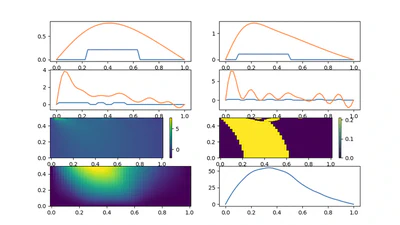
More recently, I have taken an interest in reachability analysis. I co-supervised the PhD thesis of Ivan Hasenohr with Camille Pouchol and Yannick Privat, during which we developed computer-assisted proofs of reachability and non-reachability.
Education

PhD in applied mathematics

2016-10-01
2019-10-25

Laboratoire Jacques-Louis Lions

Master 2 in applied mathematics

2015-09-01
2016-07-31

Université Pierre et Marie Curie (now Sorbonne University)

Engineering degree

2012-09-01
2015-07-31

Ecole polytechnique

Interests

Mathematical control theory PDE analysis Optimal control Optimization
📚 My Research

My research lies on the theoretical side of applied mathematics: I mainly work with abstract models to study their properties in terms of control theory. Are they controllable? Stabilizable? Why? What if we add constraints? What if we are looking for optimal controls?

My background makes me a thoroughly theoretical researcher, and I try to let that shape how I look at practical problems. Conversely, I try to let practical considerations shape my theoretical problem solving. In that spirit, I have been looking into constructive methods for some time now: in control theory, there are situations and methods that allow us to complement classical existence results with some information on the solutions. These can lead to strong characterisations and/or numerical approximations.

In stabilisation, my co-authors and I have contributed several key insights to expand the constructive method that is backstepping, to general control systems in infinite dimension. This method consists in solving an more complex problem than stabilisation, which requires more work but rewards us with more information on the feedback law, in the best cases an explicit expression.

In controllability and reachability analysis, our use of duality theory leads to constructive characterizations of admissible controls or certificates of non-reachability. This allows for their numerical approximation, and sometimes even their numerical certification in the case of non-reachability.

Featured Publications

Generalisation of Farkas' lemma beyond closedness: a constructive approach via Fenchel-Rockafellar duality

Farkas' lemma is an ubiquitous tool in optimisation, as it provides necessary and sufficient conditions to have $b \in A(P)$, where $P$ is a closed convex cone, $A$ is a …

camille-pouchol

Generalized backstepping and Gramian methods for spectral assignability in infinite dimension

In this article, we explore connections between two stabilization methods: Gramian stabilization and backstepping (and more generally F-equivalence). These methods are related to …

ludovick-gagnon
Computer-assisted proofs of non-reachability for linear parabolic PDEs under bounded control constraints featured image

Computer-assisted proofs of non-reachability for linear parabolic PDEs under bounded control constraints

Analysing reachability associated to a control system is a subtle issue, especially for infinitedimensional dynamics, and when controls are subject to bounded constraints. We …

ivan-hasenohr
Approximate control of parabolic equations with on-off shape controls by Fenchel duality featured image

Approximate control of parabolic equations with on-off shape controls by Fenchel duality

We consider the internal control of linear parabolic equations through on-off shape controls, with a prescribed maximal measure. We establish small-time approximate controllability …

camille-pouchol
Recent Publications